

Does this sound familiar?
You start running with the best of intentions. Within a few weeks you are going further and faster, you have more energy, and you are starting to enjoy it.
Then a pain appears in or around the front of your knee, perhaps 3km into a run, perhaps 5 or 6km in. At first it settles afterwards and you do not notice it at rest. Over time it comes on sooner and begins to bother you on stairs, after sitting for a while, or on a walk.
So you stop running to rest it. The pain eases, and returns as soon as you start again. It is a frustrating cycle, and a very common one.
What is going on
Knee pain in runners can have several causes. One of the most common, particularly when activity has increased quickly, is patellofemoral pain, often called runner’s knee. It is pain from the joint between the kneecap and the thigh bone.
Bodies adapt well to being asked to do more. Bones, muscles and tendons all get stronger in response to load. The catch is that this takes time. If the running builds up faster than the knee can adapt, it becomes irritable and sore. Rest calms it down, but rest alone does not make the knee any better prepared for the next run, which is why the pain so often comes back.
What helps
Runner’s knee usually responds well to two things together: strengthening the muscles around the knee and hip, and a gradual return to running.
Two exercises to start with
Both should feel like work. Mild discomfort that settles quickly afterwards is acceptable. If the pain is sharp or lingers into the next day, do less, or stop and have it assessed.
Wall assisted squat

- Stand with your back against a wall, feet shoulder-width apart and about 30cm away from the wall.
- Lower your body by bending your knees until your thighs are parallel with the ground.
- If this position is too painful, lower yourself only until your knees are at a 45° angle.
- Hold for 3 to 5 seconds and return to the start.
- Repeat 12 times and complete 3 sets daily.
Glute bridge
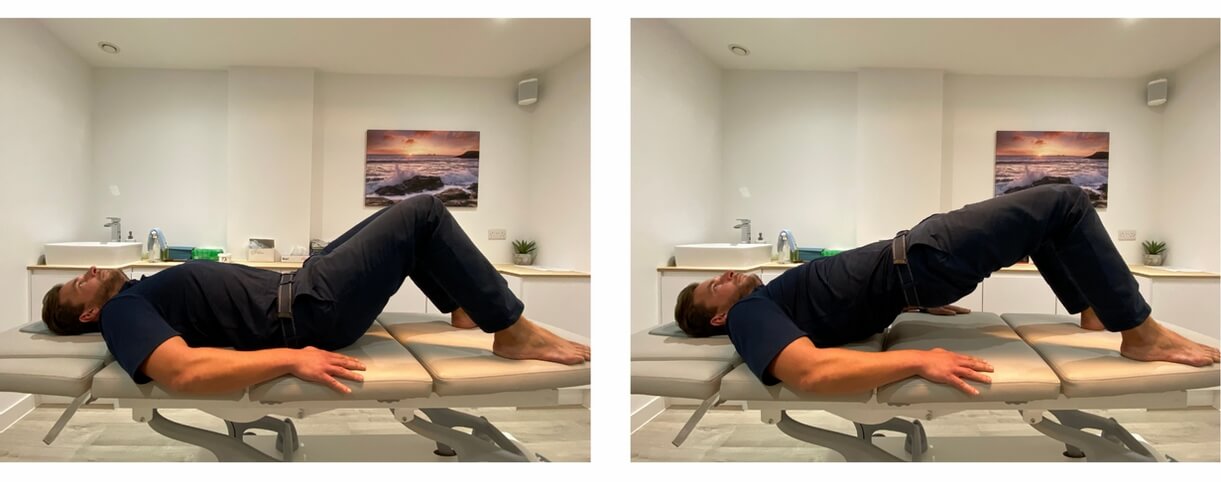
- Lie on your back with your feet flat on the floor and your knees bent to 90°.
- Squeeze your buttocks and lift your hips until your shoulders, hips and knees are in line.
- Hold for 2 seconds and return to the start.
- Repeat 12 times and complete 3 sets daily.
Getting back to running
Once day-to-day symptoms have settled, start with shorter, slower runs than you were doing before, on flat ground, with a rest day in between. Build distance first and speed later, and change one thing at a time. If the knee is no worse the next morning, you are doing about the right amount.
When to get it looked at
It is worth having your knee assessed if the pain is not improving after a few weeks of this approach, if it swells, locks or gives way, or if it is keeping you awake at night. An assessment looks at the knee itself, your strength and movement, and your training, so that we can tell you what is causing the pain and give you a plan built around the running you want to get back to.
Kirk Proto, Physiotherapist, The Health Hub