
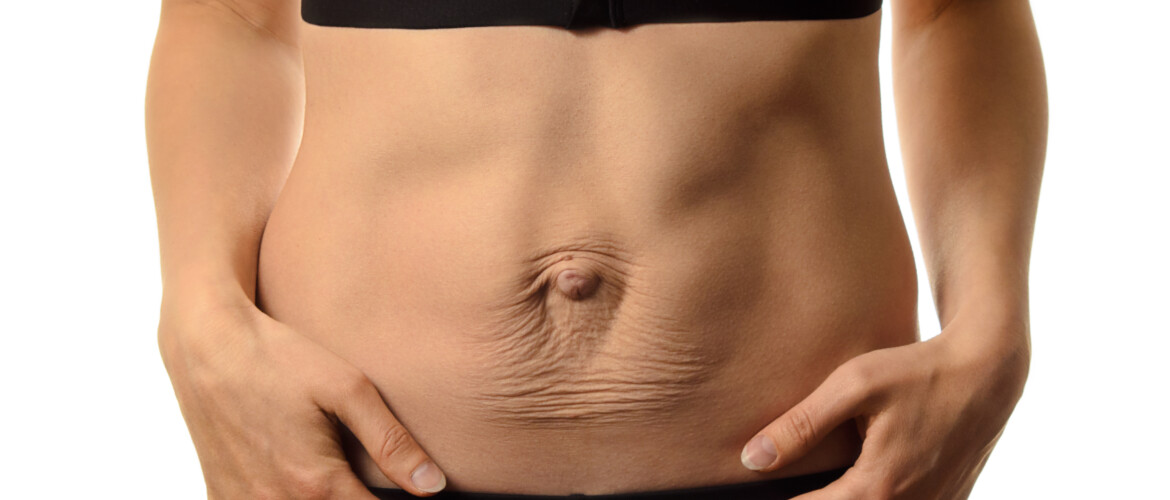
If your tummy still looks pregnant months after giving birth, if you’ve noticed a ridge or “doming” down the middle of your stomach when you sit up, or if your midsection just feels oddly soft and unsupported, you may be dealing with diastasis recti.
It’s extremely common. It’s also widely misunderstood, and there is a lot of frightening nonsense about it online. Here’s a straightforward self-check you can do at home in two minutes, what the result actually means, and when it’s worth having it assessed properly.
What is diastasis recti?
Your “six-pack” muscle, the rectus abdominis, runs in two vertical bands down the front of your abdomen. Between them sits a band of connective tissue called the linea alba.
During pregnancy, that connective tissue stretches and thins to make room for your growing baby. This is normal and necessary. It happens to some degree in the vast majority of women by the third trimester.
Diastasis recti is when that separation persists after birth. The two bands sit further apart than they should, and more importantly, the tissue between them doesn’t generate enough tension to transmit load across your midline.
That second point is the one that gets missed. Most people fixate on the width of the gap. In practice, what your physiotherapist is far more interested in is how the tissue behaves under load, whether it stays taut and springy, or whether it sinks and gives way when you brace. A narrow gap with poor tension can cause more problems than a wider gap with good tension.
The signs to look for
- A visible ridge, dome or “tenting” down the centre of your tummy when you sit up from lying, get out of the bath, or lift your baby
- A persistent “still pregnant” appearance, particularly by the end of the day
- A soft, hollow or unsupported feeling through your midsection
- Lower back pain or pelvic pain that hasn’t settled
- Bloating that seems disproportionate
- Feeling that your core “doesn’t switch on” no matter how many exercises you do
- Bladder leaking or a heavy feeling. The abdominal wall and pelvic floor work as one system, so problems often travel together
The two-minute self-check
When to do it: any time from around six weeks postnatal. Earlier than that, everything is still settling and the result won’t tell you much.
Step 1: Get into position
Lie on your back with your knees bent and feet flat on the floor or bed. Head down, shoulders relaxed. Take a couple of easy breaths.
Step 2: Find your midline
Place the fingers of one hand just above your belly button, fingertips pointing down towards your feet, across the midline of your tummy. Press gently into the soft tissue.
Step 3: Lift your head
Slowly lift just your head and the tops of your shoulders off the surface, as if starting a very small crunch. Don’t come all the way up; this isn’t a sit-up.
Step 4: Feel what happens
As you lift, you should feel the two bands of muscle contract on either side of your fingers. Note two things:
- Width: how many fingers fit comfortably in the gap between them? One, two, three, more?
- Depth and tension: this matters more. Do your fingers sink in easily, or does the tissue push back? Does it feel like a taut trampoline, or like it gives way?
Step 5: Repeat in three places
Check at your belly button, roughly 5cm above it, and roughly 5cm below it. Separation is often widest in one spot and it’s useful to know where.
Step 6: Watch as well as feel
Do the same lift without your hand there and look down. Does a ridge or dome pop up along the midline? Doming under load is one of the clearest signs that the tissue isn’t managing pressure well.
Write down what you find. Width in fingers at each of the three points, plus whether the tissue felt firm or soft, plus whether you saw doming. Repeat monthly and you’ll have a genuinely useful record of your own progress.
What your result means
Under two fingers, firm tension, no doming. This is generally within the normal range. Keep building strength progressively.
Two to three fingers, some give. Common at a few months postnatal, and very responsive to appropriate rehabilitation. Worth getting proper guidance so you’re training the right things in the right order.
Three or more fingers, and/or the tissue sinks with obvious doming. Worth a professional assessment. This isn’t cause for alarm. It is cause for a plan, rather than guesswork.
A word of reassurance: the goal of rehabilitation is not always to close the gap to zero. For some women the gap narrows considerably; for others it stays similar in width but becomes much more functional as tension improves and symptoms resolve. Function is the target, not a number.
Why self-checking has limits
A finger-width test is a useful starting point, but it’s a fairly crude measure. Studies looking at how reliably the finger test can be reproduced, even between clinicians, have found meaningful variation. You’ll feel differently on a day you’re bloated, differently again if you press harder.
That’s why a proper assessment looks well beyond the width of the gap. At The Health Hub in Haywards Heath, your women’s health physiotherapist examines how your abdominal wall behaves as you breathe, brace and move, alongside your pelvic floor, posture and symptoms.
We also use real-time ultrasound, not to measure the gap, but to help you learn to activate your deep core. The image goes up on a screen, so you can see your own deep abdominal muscles switching on and off as you work them.
For a lot of women, that screen is the turning point. When you’ve been told for months to “engage your core” without ever really knowing whether you were doing it, seeing the muscle respond in real time changes everything.
What actually helps
Diastasis rehabilitation is strength and coordination training, delivered in the right order. A typical plan involves:
- Breathing and pressure management first. How you exhale, brace and lift determines how much pressure lands on your midline every single day.
- Deep core reconnection. Getting your transversus abdominis and pelvic floor working together, with real-time ultrasound so you can see you’re activating the right muscles.
- Progressive loading. The connective tissue adapts to load, so avoiding all effort forever is the wrong approach. The skill is in progression, not avoidance.
- Whole-body strength. Hips, glutes, back and shoulders all contribute to how your trunk manages force.
- Clinical Pilates-based exercises, which suit this work well. Jodie and Corinna are both APPI Pilates trained and build these exercises into your individual rehab plan.
- Addressing the pelvic floor at the same time. They are one pressure system, and treating one while ignoring the other rarely works.
On the exercises to be careful with: traditional sit-ups, crunches, full planks and heavy twisting movements are often too much too soon, particularly if you dome under load. That doesn’t mean never; it means not yet, and reintroduced under guidance.
Get it assessed properly in Haywards Heath
A Mummy MOT® with Jodie Pargeter includes a full diastasis assessment alongside pelvic floor, posture, breathing and scar checks, and you leave with a clear explanation of what we found and a tailored rehab plan.
We see women from Haywards Heath, Lindfield, Cuckfield, Burgess Hill, Hassocks, Hurstpierpoint and across Mid Sussex, from six weeks postnatal to many years down the line. It is genuinely never too late; we regularly assess women whose “baby” is at secondary school.
Mummy MOT® / New Mum MOT · £94
Initial women’s health assessment · 60 minutes · £94
Frequently asked questions
How soon after birth can I check for diastasis recti?
Around six weeks is a sensible point. Before that, your tissues are still changing rapidly and the result won’t mean much.
Can diastasis recti be fixed without surgery?
For most women, yes, appropriate progressive rehabilitation improves function and symptoms substantially. A small number with very large separations may be referred on for a surgical opinion, but that’s the minority, and physiotherapy is the sensible first step regardless.
Is it too late if I gave birth years ago?
No. The abdominal wall responds to training regardless of how long it’s been. A meaningful proportion of the women we assess are several years postnatal.
Do men get diastasis recti?
Yes, though far less commonly, usually related to significant weight change or repeated poorly managed heavy lifting.
Will it come back if I have another baby?
Some separation will happen again in any pregnancy; that’s normal. Going into the next pregnancy with a well-conditioned core and pelvic floor generally makes recovery afterwards easier.
Can I still exercise while I have a diastasis?
Yes, and you should. It’s about choosing and progressing the right exercises rather than stopping, which is exactly what the assessment is for.
Book your assessment
Two minutes of self-checking tells you whether it’s worth looking into. An hour with a specialist tells you what to do about it.
Book a Mummy MOT® with Jodie Call 01444 817851
Prefer to talk it through first? Call the clinic and we’ll help you choose the right appointment.
The Health Hub, Haywards Heath: women’s health physiotherapy for Mid Sussex.